 |
| Shivalinga of Baba Ajgaivinath and images of Parvati and Ganesha on the wall at Sultangunj, Bihar |
Sultangunj is famous as a place from where millions of devotees take the holy water of Ganga in the Hindu month of 'Sawan' and go on foot or by other means to Baba Baidyanathdham, Deoghar, Jharkhand (distance about 100 km) to offer it to "Jyotirlinga" of Shiva. It is situated on the southern bank of the Ganga in Bihar. For Hindus Ganga is a holy river that flowed in the heavens and King Bhagirath brought it on the earth after hard penance to give "Moksha" to his forefathers who were cursed to death. When Ganga came to earth with tremendous force God Shiva took it in his "Jata" (tress) to slow its force. She is liked by Shiva, so the water of this holy river called "Gangajal" is also considered holy and used in worships. The flow of river Ganga at Sultangunj is Northwards so its importance increases ("Uttarvahini Ganga"). Though Sultangunj is situated in the plains of Ganga and hills are not in sight all around the horizon, at the "Ghats" of Ganga one can see the two small hillocks a few hundred meters apart. On one of them, a mosque is constructed while on the other is the temple of "Ajgaivinath". It is said that the mosque was made in place of a "Parvati" temple by "Kalapahad" (A converted Muslim who had destroyed many temples and made thousands of Hindus accept Islam) but he could not destroy the Shiva temple on the other hill. According to Hindu mythology, the hill of "Ajgaivinath" was once the ashram" of "Jahnu Rishi" and many students came to his Ashram to get his teachings and education. In the modern history this place is related to a Shiva devotee named Harinath who used to go to Baba Baidyanathdham, Deoghar regularly. One day Shiva told him in his dreams that Harinath would not come to Deoghar but Shiva himself would come as "Shivalinga" at "Ajgaivinath". Harinath found the dream to be true. So he built a temple at the hill and became the first "Mahanth" here.

The Pundit ji was wearing Dhoti over the Jeans Pant.
In the background the Mosque on the hill at
Sultangunj, Bihar

In the background the Mosque on the hill at
Sultangunj, Bihar
I had visited here many times before with my family for a few dips in the holy river Ganga (called "Ganga-snan") and fetch "Gangajal" for worships at home and to offer it to Shiva at Baba Baidyanathdham, Deoghar and Baba Basukinathdham, Dumka. The last visit here was from Dumka. I had some work at Dumka, Jharkhand. When my wife knew it, she told me that remaining "Gangajal" at home was very less in quantity and some old aged relatives had passed away in the last year so we need "Ganga-snan" and "Gangajal". Since I could spare only one more day outside home so we agreed that in that day we shall take dips in Ganga and fetch "Gangajal" and return back to home. We had not an extra day to visit to the temples of Baba Baidyanathdham, Deoghar and Baba Basukinathdham, Dumka which otherwise was a must for us. Since nearest "Ganga-ghat" from Dumka is at Bhagalpur, Bihar, we planned to hire a taxi from Dumka to bathing "Ghat" near Barari, Bhagalpur in that morning so that we could return to Jasidih railway station in the evening to board our train.
 |
| Baba Ajgaivinath Temple at Sultangunj Bihar |
As per plan I with my mother and wife reached Dumka on the fixed date in the morning and stayed at a hotel. I had my work done in the first half of the day so we all took our lunch and rested. In the evening I contacted the staff at counter of the hotel for hiring a taxi for the next day, he tried but did not succeed. Dumka is a small town and these hotel staffs are not so professional. So I went to taxi stand near bus stand and talked to one of the taxi drivers. He told me the rates that was higher than the normal because the road to Bhagalpur was in its worst condition. But he himself was unable to go next day due to some urgent work, so he talked to another taxi driver on phone who was ready to go. I too talked to him and fixed the time at 6:00 AM in the morning.

A view of Ajgaivinath Temple from
Parvati Mandir at Sultangunj, Bihar
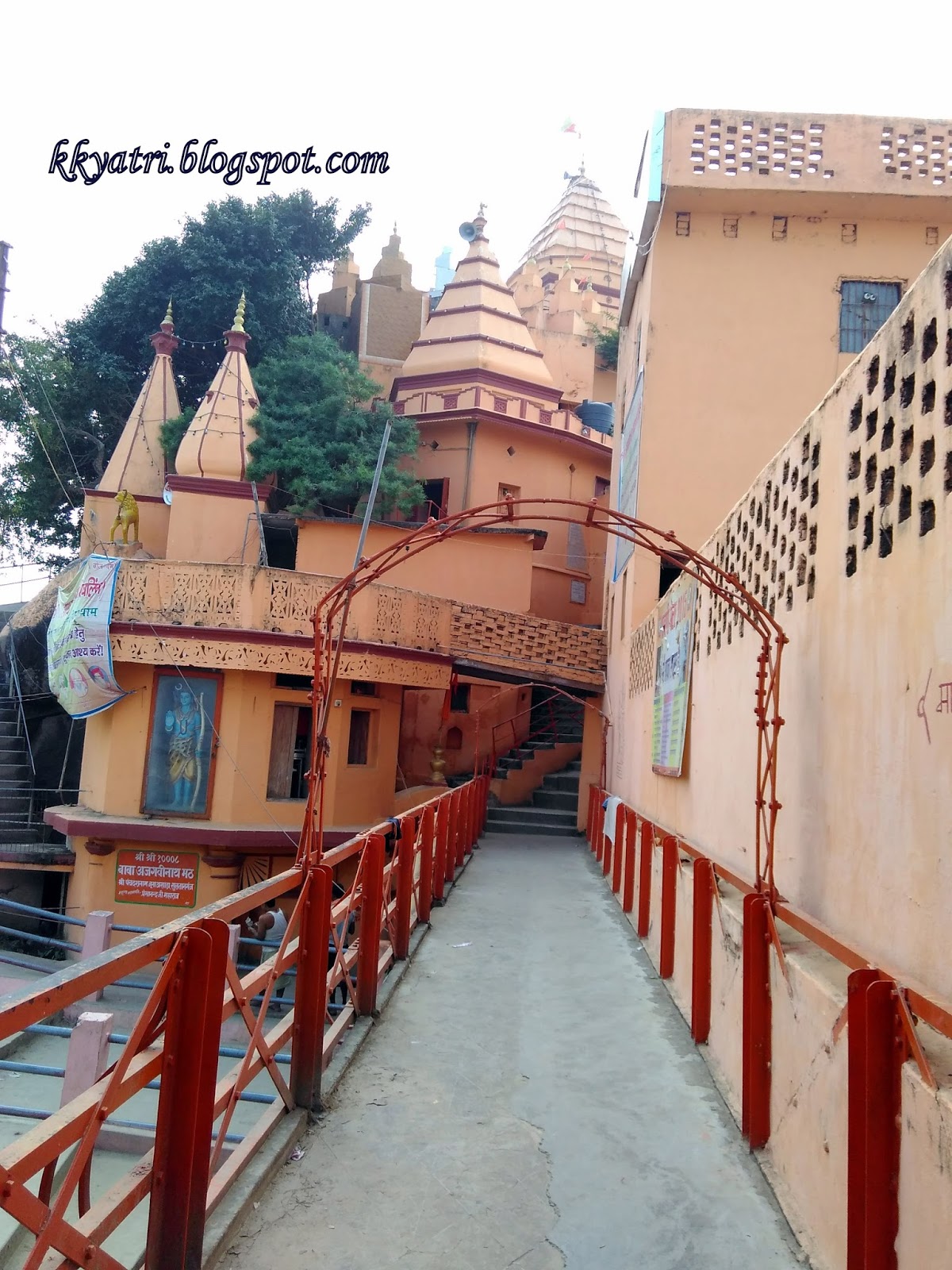
Parvati Mandir at Sultangunj, Bihar
Next morning we got ready by 6:00 AM and waited for the taxi but it had not come till 6:30 AM, so I ringed the driver, he told, "taking breakfast, just coming." Next time he told,"I am on the way." Again I dialed, he answered,"I am just near your hotel". Next he switched off the phone and nowhere he or his taxi was in sight. I got anxious because we were getting late. It was already 7:30 AM. The hotel staff told me that he could arrange a taxi but it will take about an hour because he would have to go to residence of the taxi owner. I had no other way in my mind. Just when I was to say OK to him my phone ranged. It was an unknown number. When I picked up the call, it was another driver named Gopal. He asked me that if "Ganga-snan" is the purpose, would I go to Sultangunj instead because due to the road condition no driver would agree to go to Bhagalpur. He was true. Even we would have exhausted in travelling on that road. I asked him, "If I agree, how much time would you take to come to hotel". He told me,"five minutes". I asked him to come as soon as possible. Thus our destination changed to Sultangunj due to turn of the events. He came within 15 minutes. My wife wanted to take a cup of tea before starting the journey. We all took tea in "Kulhads" at the famous tea-shop of Dumka - at Gopi's tea shop. Then saying "Bol-bum" we started our journey to Sultangunj.
We took the route via Deoghar. Distance from Dumka to Sultangunj via Deoghar is about 175 km, while our previous planned route Dumka - Bhagalpur was about 120 km. So we had to cover extra 55 km to Sultangunj. But this route was good except a few places. On the other hand Dumka - Bhagalpur road was almost non-motorable. Our current journey was to take more than 4 hours. So we were to reach Sultangunj not before 12 noon. Our aim was to do "puja" (worship) at "Ajgaivinath" after "Ganga-snan". So till "puja" we could take only tea or milk. After two hours of driving we reached "Katoria". Here we stopped for fifteen minutes and took tea. From Katoria one road on the right turn goes to Banka while the road on the left turn goes to Sultangunj. The point at which one or more roads join are called "Mode -मोड़" in local language. So this was "Katoria mode". We took left turn from here. Journey ahead was interesting because the route was through a valley and scenery was awesome. Along came a place named "Suiya Pahad". Its meaning is "hill of needles. This name is due to the small fragments of stones here have sharp edges. This place is on the pedestrian route for "Kanwariyas" (who fetch two pots of 'Gangajal' at Sultangunj and hang them on both ends of a bamboo part and keep it on the shoulders) from Sultangunj to Baba Baidyanathdham, Deoghar. Since they walk bare footed, this place gets very difficult to walk for them. Sharp edges of small stones under the feet hurts badly and sometimes they bleed.
 |
| A view of Holy river Ganga at Sultangunj and Chowkis at Ganga-ghat |
After the hilly area, begins the plain of Ganga. You will see continuous paddy fields up to you can see. The vast even stretches are dotted with some villages. Around 12:30 PM we reached the railway over-bridge at Sultangunj. The driver asked local people for the directions at two or three places because we had to take turns at some places in the busy market roads. The driver took the taxi at the 'Ghat' parking that was very near to the "Ajgaivinath" hill. Ganga was flowing about 15 ft down from here. Many wooden "Chowki" were placed on the ghat slope. These are placed by sellers of worship items or flowers. These sellers provide you dry "Chowki" on which clothes can be put during "Ganga-snan". But you have purchase things from this seller only. Since we arrived late here, very few sellers were there. A lady flower seller with a 6 yrs child asked us to keep clothes at her "Chowki". Many people were still taking bath. We cautiously entered the water because the land under the water was not even and many hard things like fragments of earthen pots and plastic things (thrown by devotees) laid there. The water quality was good compared to other cities in Bihar and UP. All of three took many dips in the holy water of Ganga and filled all the pots we took with us for this purpose. My wife also took some fine clay of Ganga beneath the water which is called "Mrittika" (मृत्तिका). This holy earth is used for many purposes related to worship. After "Ganga-snan" ladies perform Ganga-worship. For this my mother and wife purchased flowers, "Deep" (earthen lamp with ghee and cotton 'bati'), camphor, etc. from the lady seller.

Holy Banyan tree near Parvati Temple at
Ajgaivinath, Sultangunj, Bihar

Ajgaivinath, Sultangunj, Bihar
Just then came a Pundit ji who looked like a college student. In fact he was wearing a dhoti over jeans pant. He told me "the place where your vehicle is parked belongs to my area, so either you pay me Rs. 40/- or get your worship performed by me for which you will have to pay Rs 151/- as 'Dakshina' (donation)." When I talked in local language about his village and 'gotra' and also told him that I am no outsider and belong to the neighboring district, his tone of talking became mild. I told him that you take us to "Ajgaivinath" temple and perform worship but the 'Dakshina' (donation) would be as per my wish. First he tried to argue but then agreed. He first helped in performing Ganga-worship to my mother and wife then took us to the temple on the hill for worship of "Baba Ajgaibinath". He took us to the temple through a way on the right of the entrance and a short-cut. At half way we saw a cow being kept there. Just at the gate of the main temple we saw an old "Sadhu" sitting with "Bibhooti" in a "Thali" (Big plate). He was putting a "Tilak" of "Bibhooti" at the middle of forehead of the devotees coming there and in return devotees were putting coins or small notes. Inside we saw three "lingas" and and "Parvati's" image on the adjacent wall. These were the natural "lingas" of "Ajgaivinath". The Pundit ji told that at this place Shiva had taken a bow named "Ajgav", so this place was named "Ajgaivinath". From here he took us to show other idols and images of gods. We saw some some idols that were very old. Perhaps they were obtained in excavations. In fact this area have been center of arts and learning during the times of Mauryas, Guptas and Palas. At a place small idols of Buddha along with seven ft high copper Buddha statue had been recovered. Some of it were taken to museum at Birmingham by the English. A separate "Parvati" temple have been constructed at the lower level. We also went there to worship. My mother recalled the time when she occasionally used to come here for worship with her parents in her childhood, every time she saw this hillock having deep water all around. People went to temple by boats. True, the water in Ganga has decreased in volume drastically in last few decades.
After completion of worship we came back to our taxi and gave Pundit ji his "Dakshina". I took him with us to the road so that no other person will ask again for parking. After dropping him there we took our back journey. It was about 2 O'clock and we were quite hungry. About 10 km from Sultangunj we saw a "Dhaba" where some people with family were eating. Here we stopped and took our lunch. From here we went non-stop and reached railway station of Jasidih at about 6 PM. The driver Gopal brought our luggage to waiting room. I paid his bill in full and thanked him. He had to return back to Dumka and was hoping for some passenger to Dumka for some extra income. He too was happy and in a gesture of respect touched our feet at the parting time.
Thus we completed our mission for "Ganga-snan" in a wonderful way.
===<<<O>>>===
INDEX
34. Panchghagh Waterfalls (पंचघाघ झरने), Khunti/Ranchi, Jharkhand
33. Rajrappa Waterfalls, Ramgarh, Jharkhand
32. Khutta Baba Mandir and the Tenughat Dam
31. Maya Tungri Mandir - The Mahamaya Temple, Ramgarh, Jharkhand
30. Toti Jharna, Tuti Jharna Temple at Ramgarh, Jharkhand
29. ISKCON Temple and The Birla Temple at Kolkata
28. Belur Math, Howrah
33. Rajrappa Waterfalls, Ramgarh, Jharkhand
32. Khutta Baba Mandir and the Tenughat Dam
31. Maya Tungri Mandir - The Mahamaya Temple, Ramgarh, Jharkhand
30. Toti Jharna, Tuti Jharna Temple at Ramgarh, Jharkhand
29. ISKCON Temple and The Birla Temple at Kolkata
28. Belur Math, Howrah


